RONAVEMI turns evidence from a player’s own completed League of Legends matches into understandable reviews, several preparation options, and focused five-game training priorities.
Private pre-release. No public download. No Riot approval or endorsement is claimed.
CURRENT BUILD Private pre-release / Riot review
v4.5aCurrent build
Windows DesktopPlatform
Not activeLeague Client integration
Not activeRiot Sign On (RSO)
Not availablePublic download
Not distributedProduction API key
Completed-match analysis
Player-controlled decisions
Local-first data handling
Private Riot review build on request
What RONAVEMI does
Coaching after the game, preparation before the next one.
RONAVEMI is designed for self-analysis across a player’s own match history. It connects performance evidence to a manageable training focus without automating play or dictating a single decision.
01
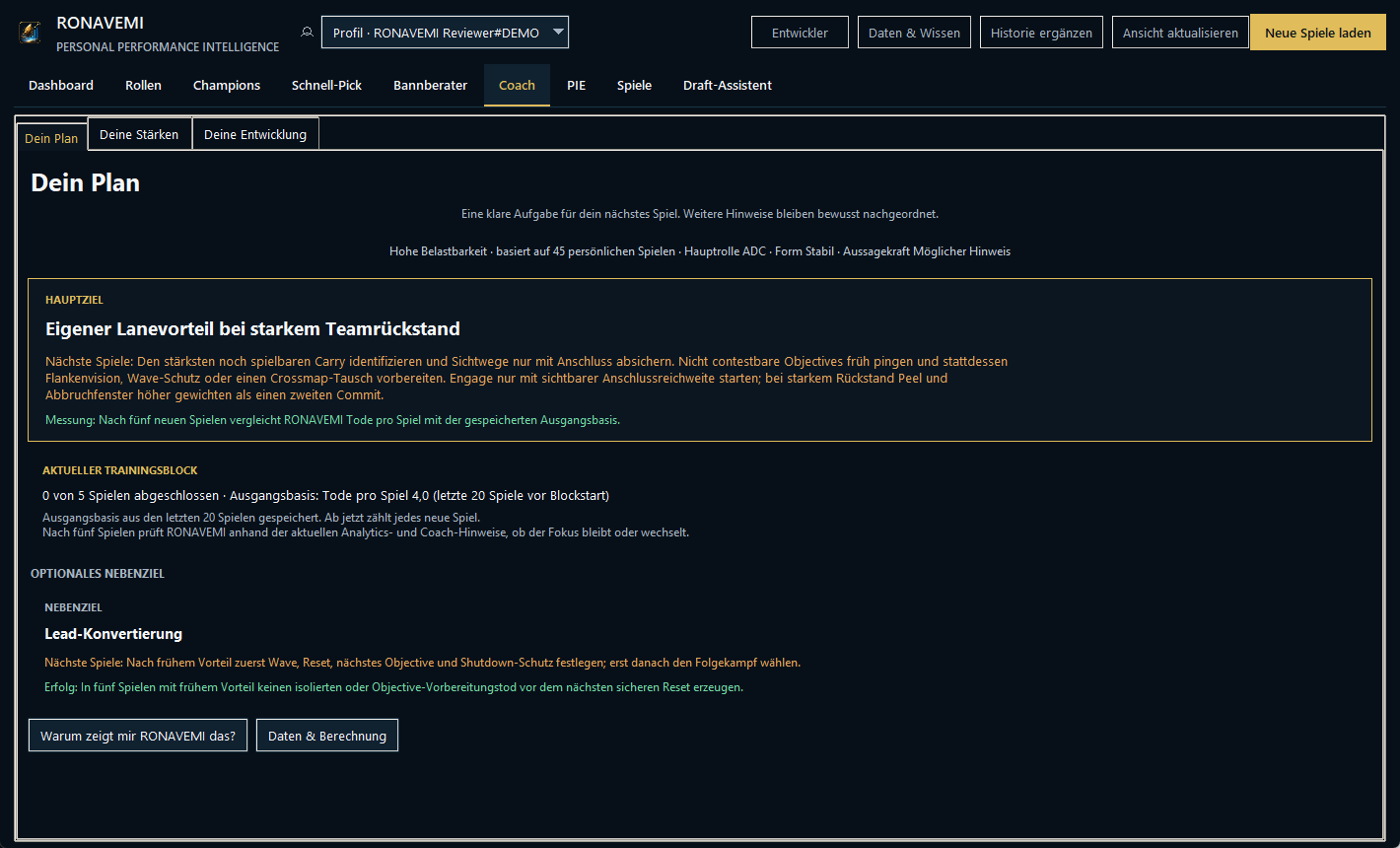
Performance dashboard
Aggregated trends across completed matches, roles, and champions make longer-term patterns easier to see.
02
Match review
Death Coach and Fight Cluster views connect post-game situations to evidence and learning priorities.
03
Training blocks
Findings become reviewable five-game priorities instead of an endless list of generic tips.
04
Preparation options
Champion-pool and draft-preparation views present several static or aggregate options with context and risks.
Real v4.5a interface
A reviewer can inspect the complete product flow here.
Every image below was captured from the accepted RONAVEMI v4.5a Tk desktop interface at commit ce725389085f3252cb68207bafb46801929ca890, tag v4.5a. The current verified Windows build has SHA-256 AAC4C76ADB919419010C5BDB4AB2E7F417996BAB5FA3998DFB8535E565A6DC60. The isolated reviewer profile and all 45 matches are synthetic. No real Riot ID, PUUID, API credential, local path, or player data is shown.
Review evidence, not a public release.The production candidate remains private. There is no public executable or production key on this website. Full-resolution images open in a new tab.
Overview and detail profiles
From account-level orientation to an opened role and champion profile.
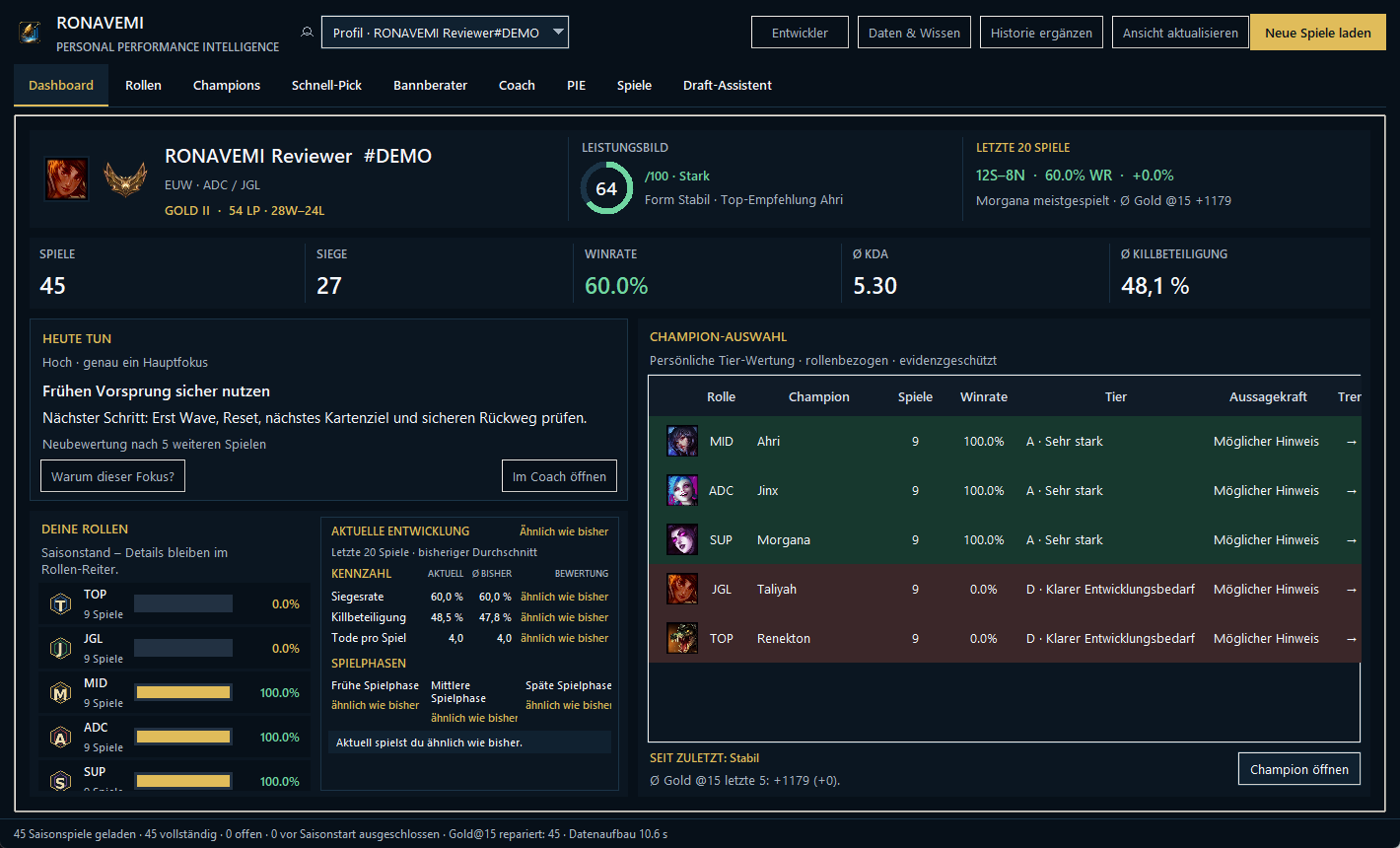
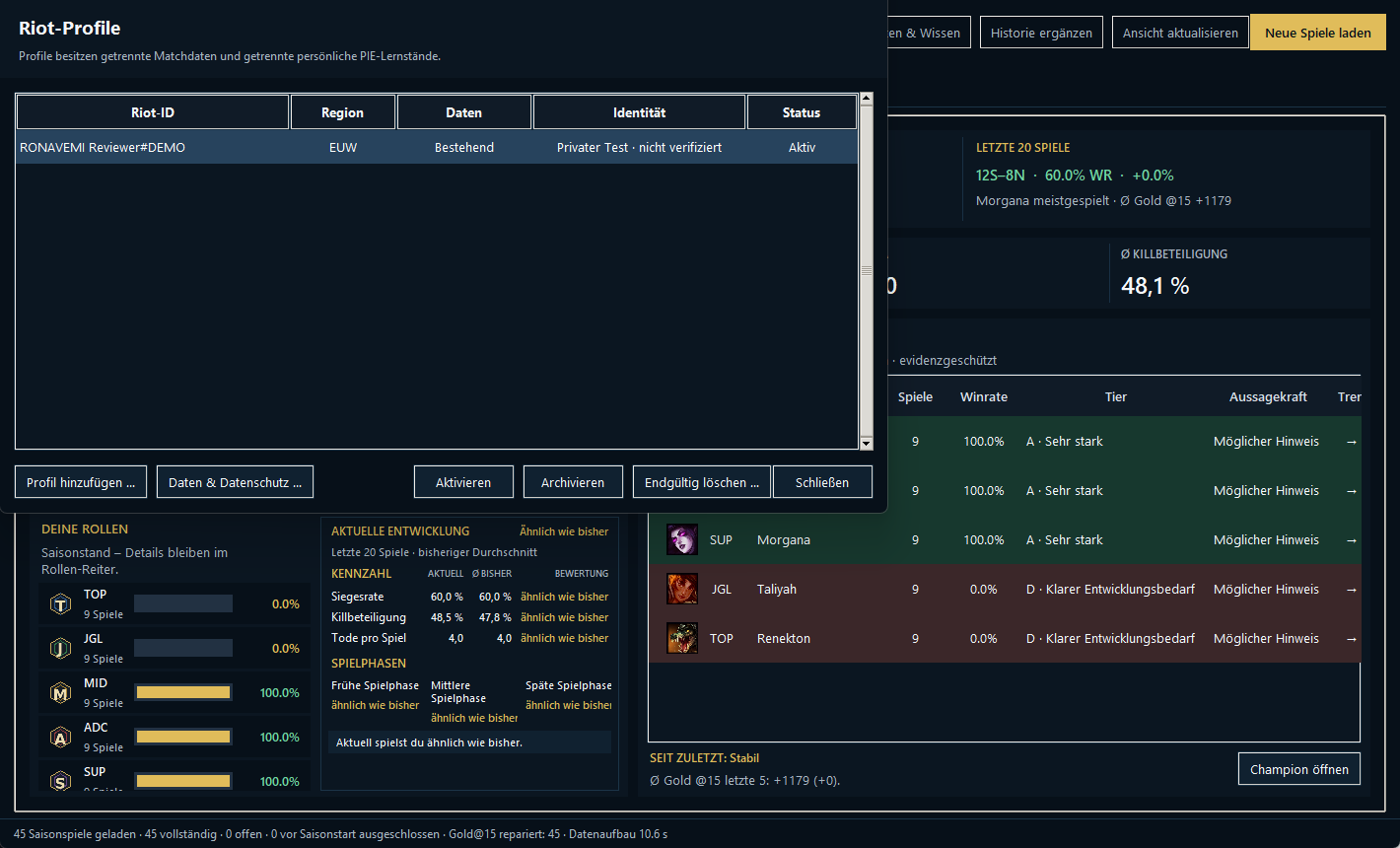
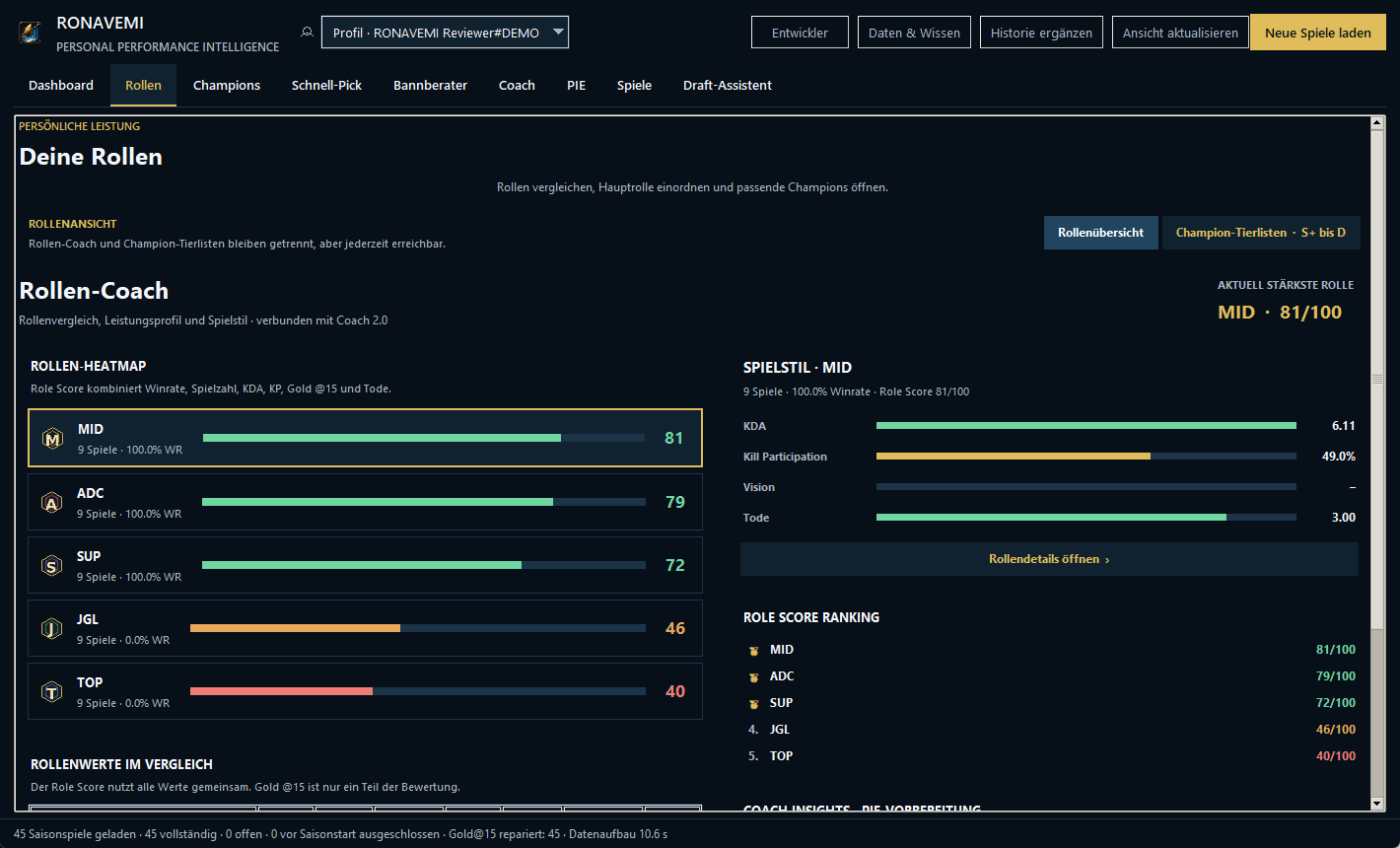
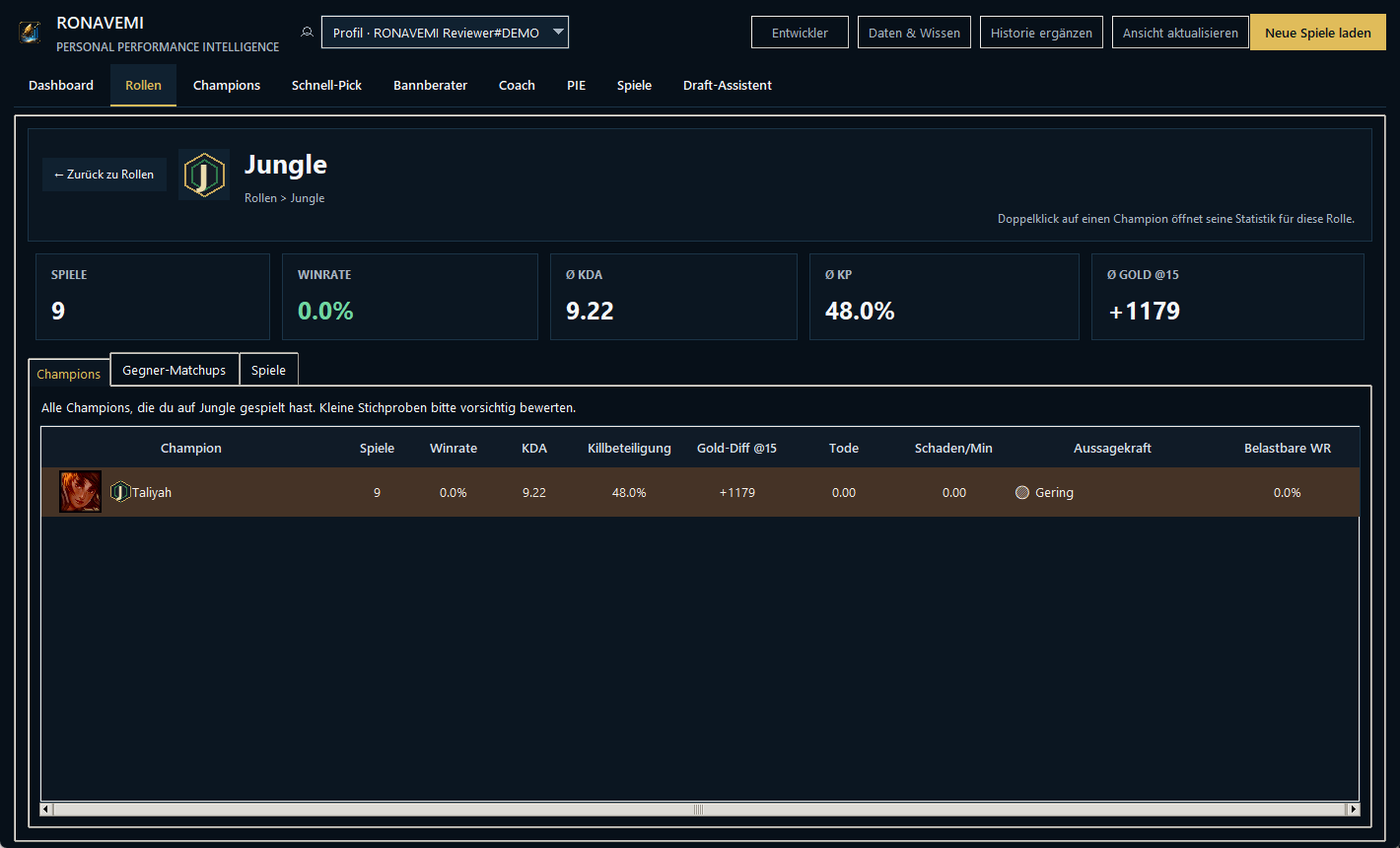
01 · DashboardRecent and historical personal performance, role evidence, champion pool and a single training focus.02 · Local profilesSeparate local histories, explicit private-test status and user-controlled privacy actions.03 · Role analysisRole sample sizes, comparative performance and clearly scoped evidence.04 · Opened role profile
Reviewer sees
An opened Jungle profile with role KPIs, played champions, matchups and completed games.
What it does
Aggregates the selected player's completed-match evidence for one role.
Player value
Makes role-specific patterns and sample strength easier to compare.
Integrity
Post-game evidence only; no live session or hidden opponent data.
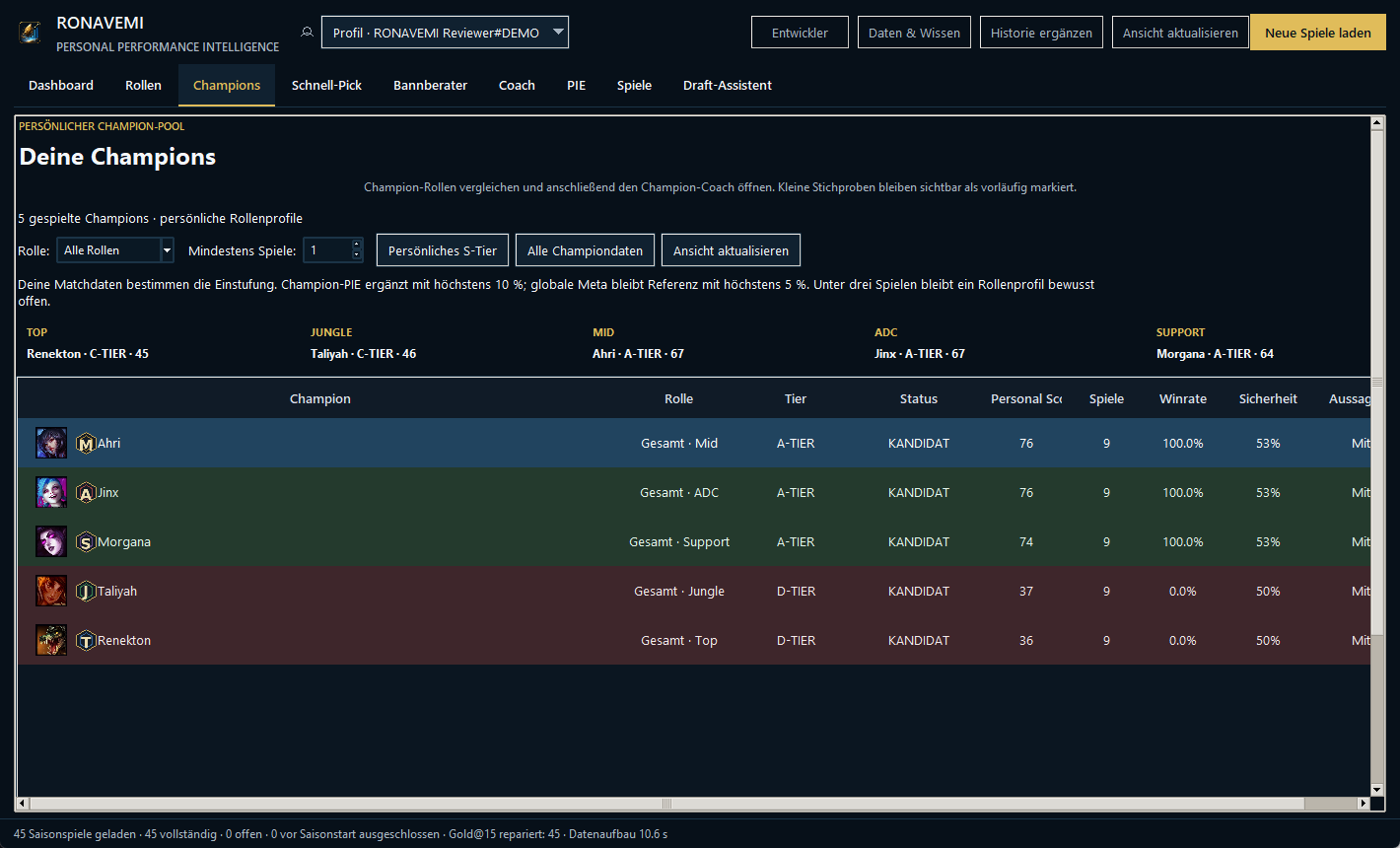
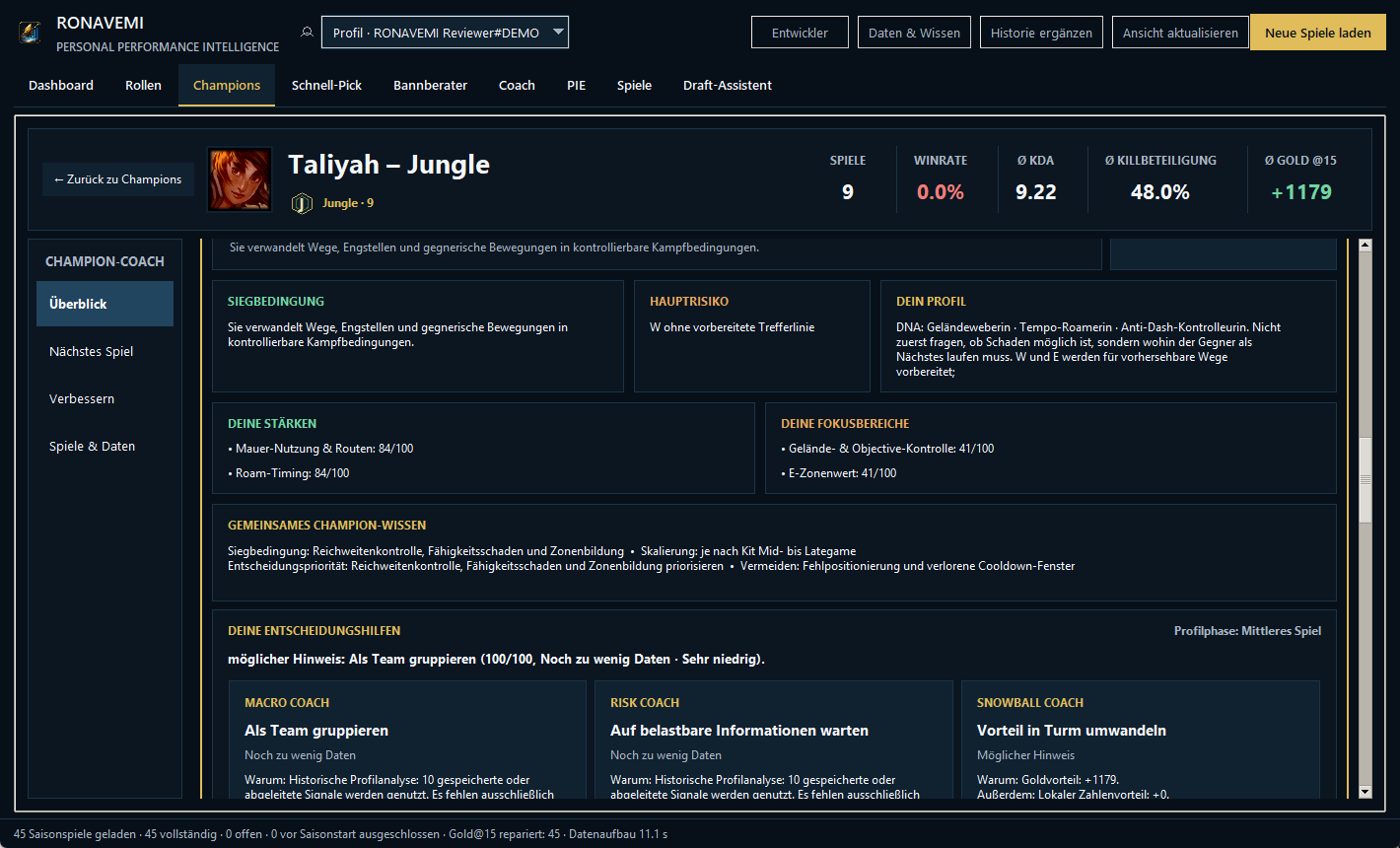
05 · Champion overviewPersonal champion history, role context, sample sizes and confidence.06 · Opened champion profile
Reviewer sees
An opened Taliyah Jungle profile with personal KPIs, identity, strengths, risk and current focus.
What it does
Combines completed-match evidence with clearly separated champion knowledge.
Player value
Turns champion history into a readable, role-specific review surface.
Integrity
Sample limits remain visible; no alternative MMR and no automated action.
Preparation for the next game
Player-controlled options and a reviewable plan, without champion-select automation.
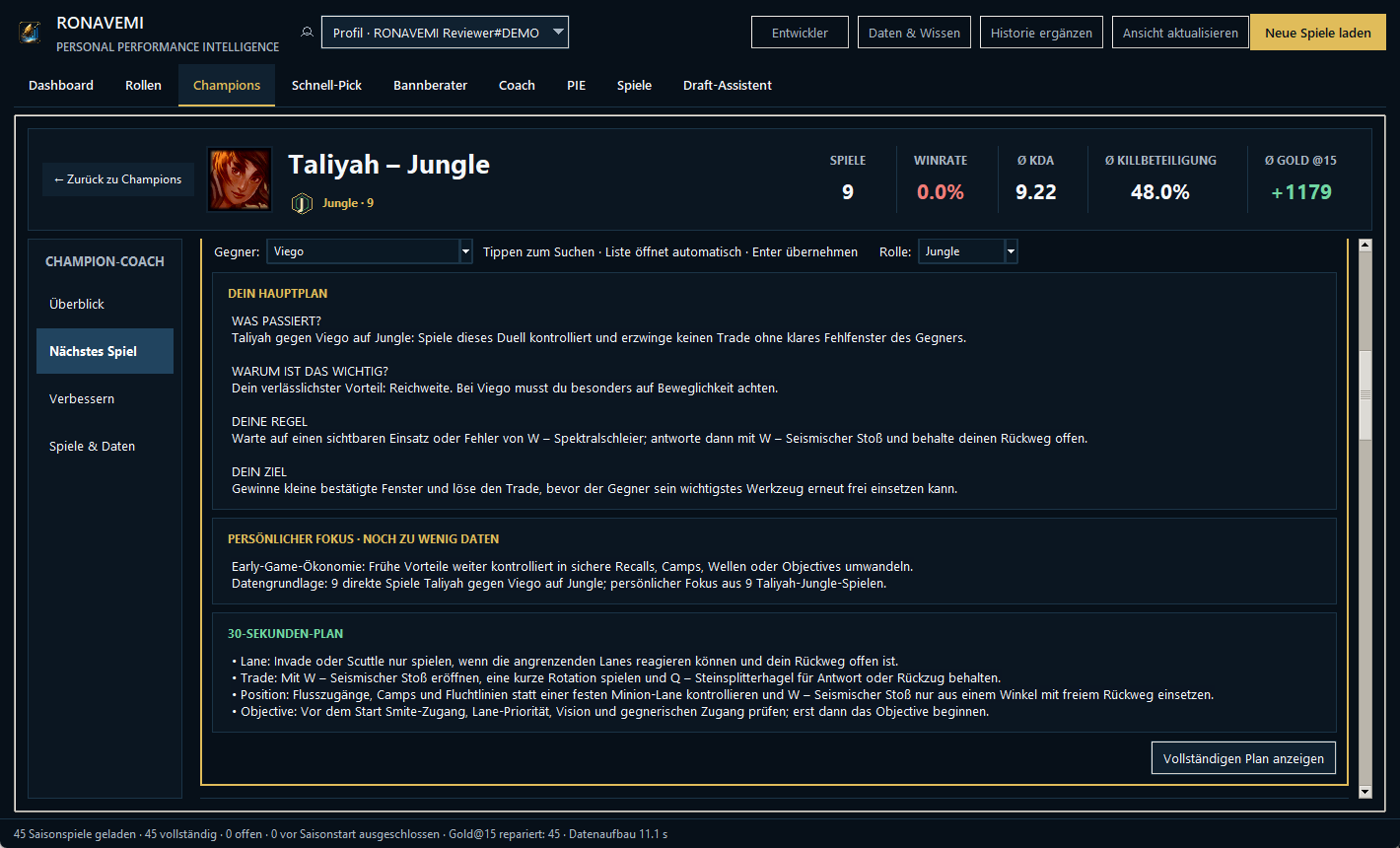
07 · Next-game plan
Reviewer sees
A user-selected Viego matchup plan with a rule, goal, personal focus and 30-second preparation summary.
What it does
Turns existing personal evidence and champion knowledge into a pre-game learning plan.
Player value
Gives the player a small, reviewable focus for the next completed match.
Integrity
Preparation only: no live read, hidden data, automation or mandatory action.
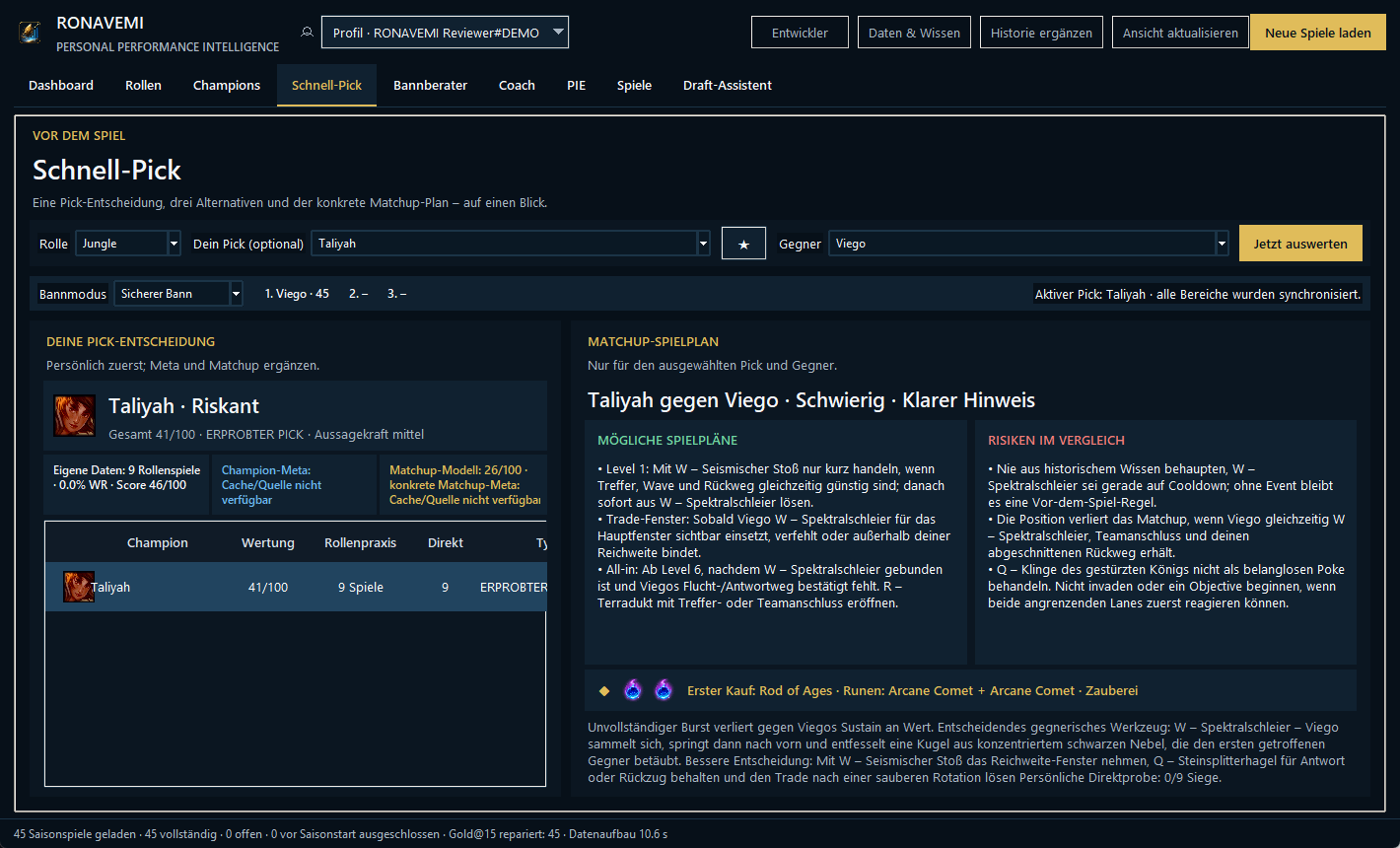
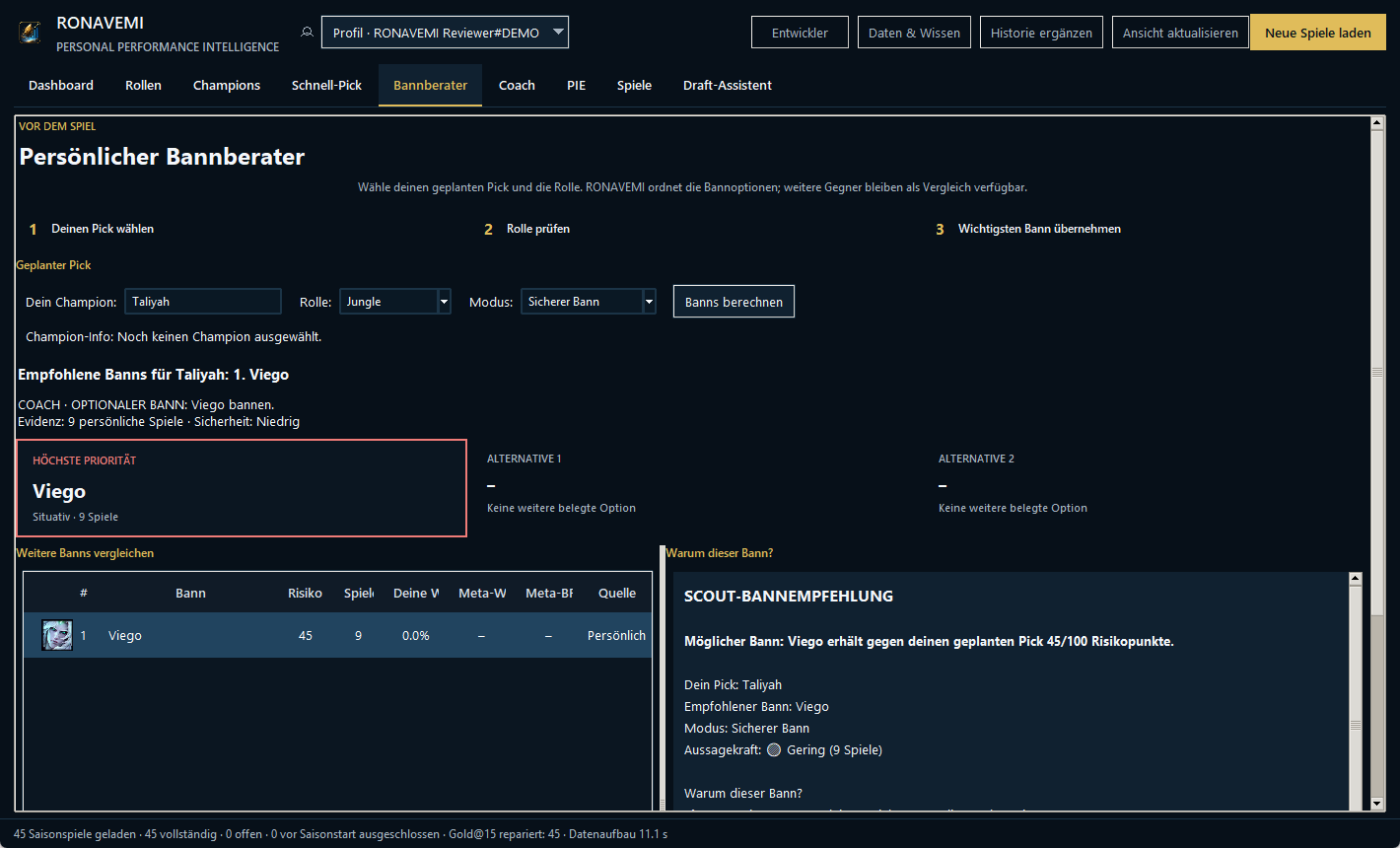
08 · Quick PickPlayer-controlled selection with alternatives, matchup plans, risks and visible evidence limits.09 · Ban Advisor
Reviewer sees
A manual Taliyah Jungle query, one optional ban, alternatives and the available evidence.
What it does
Ranks review options from the synthetic profile's completed-match evidence.
Player value
Helps the player make an informed choice while keeping confidence visible.
Integrity
User-triggered and optional; it neither reads live champion select nor performs a ban.
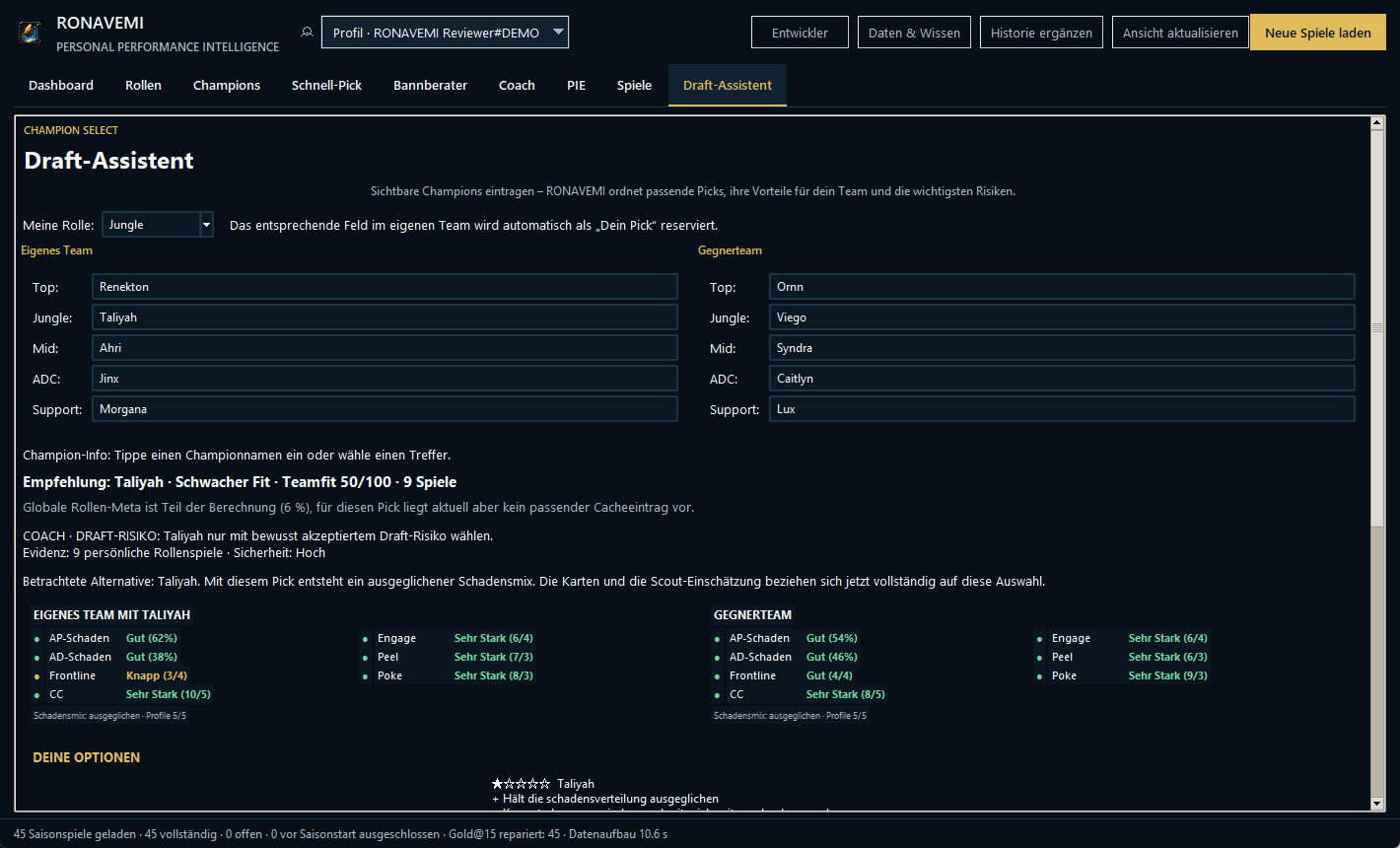
10 · Draft AssistantOnly visible champions are entered manually. The app compares options; it does not automate champion select.
Completed data and traceable analysis
Riot match data becomes a local history, then inspectable evidence for analysis.
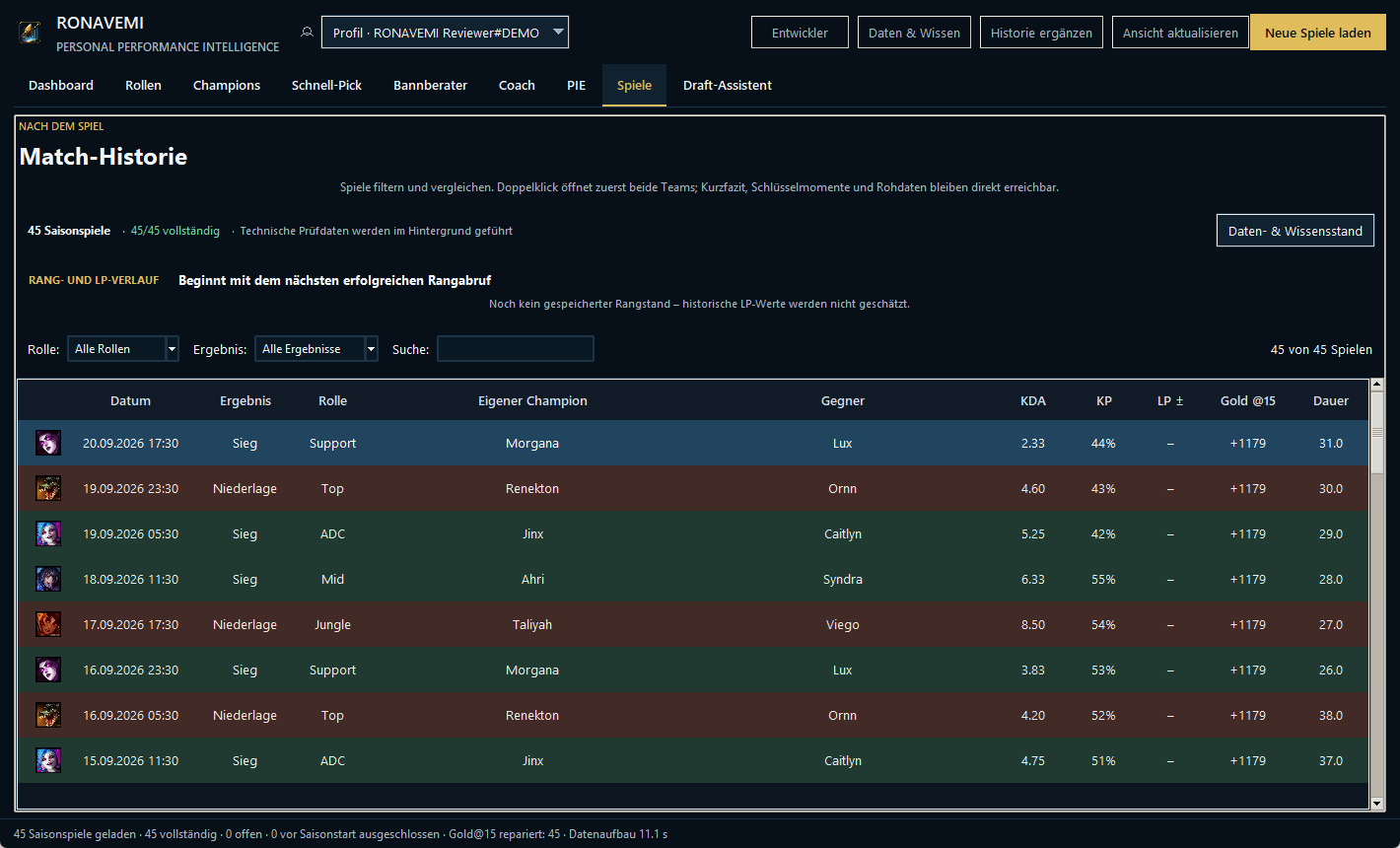
11 · Match history
Reviewer sees
A filterable history of 45 synthetic completed matches and data-completeness status.
What it does
Provides the local evidence layer used by match, role, champion and coach views.
Player value
Lets the player find a match and trace later conclusions back to source data.
Integrity
Completed-match history only; no live-game tracking.
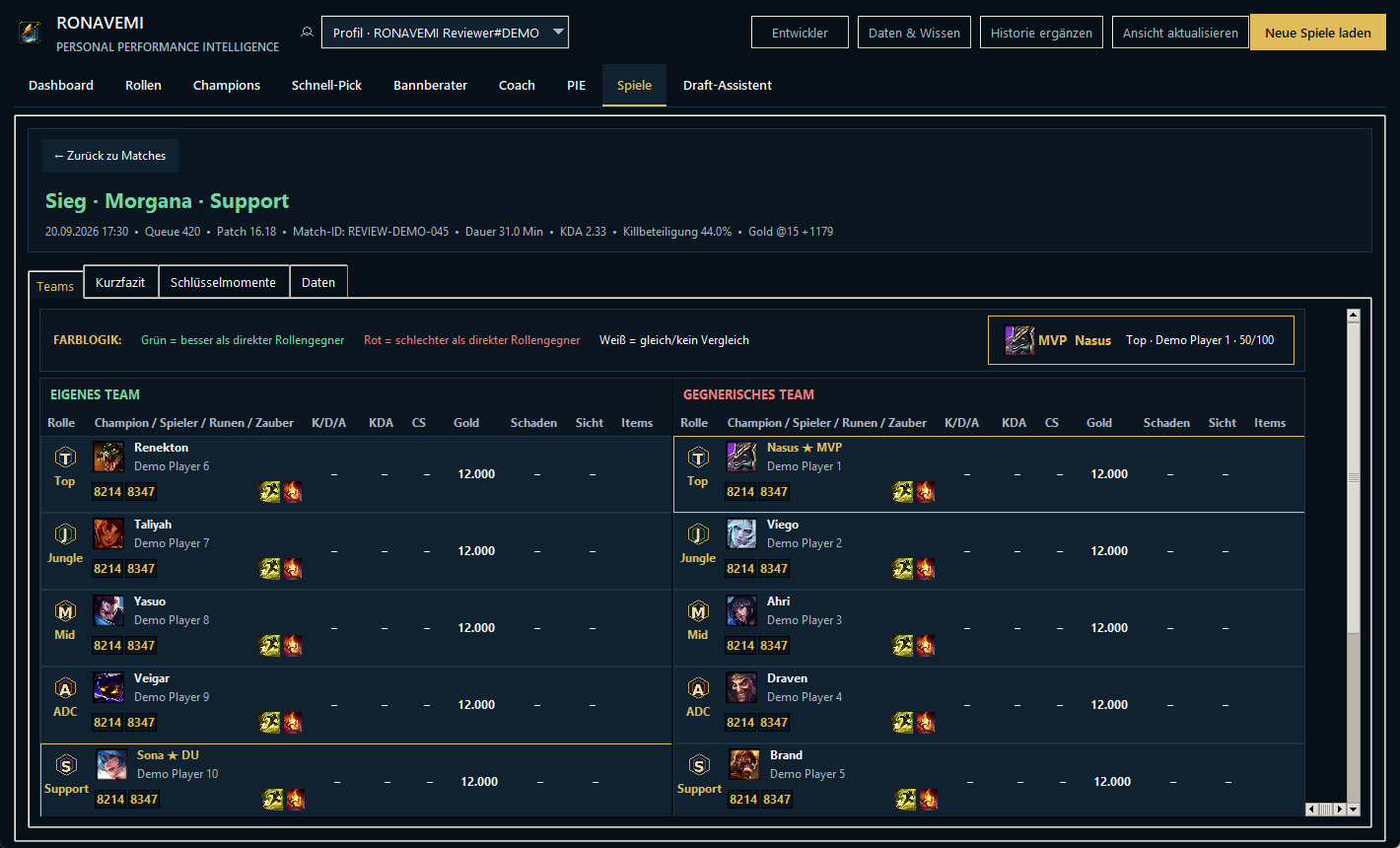
12 · Completed-match analysisRetrospective teams, timeline evidence and post-game review using synthetic player labels.13 · Champion games & data
Reviewer sees
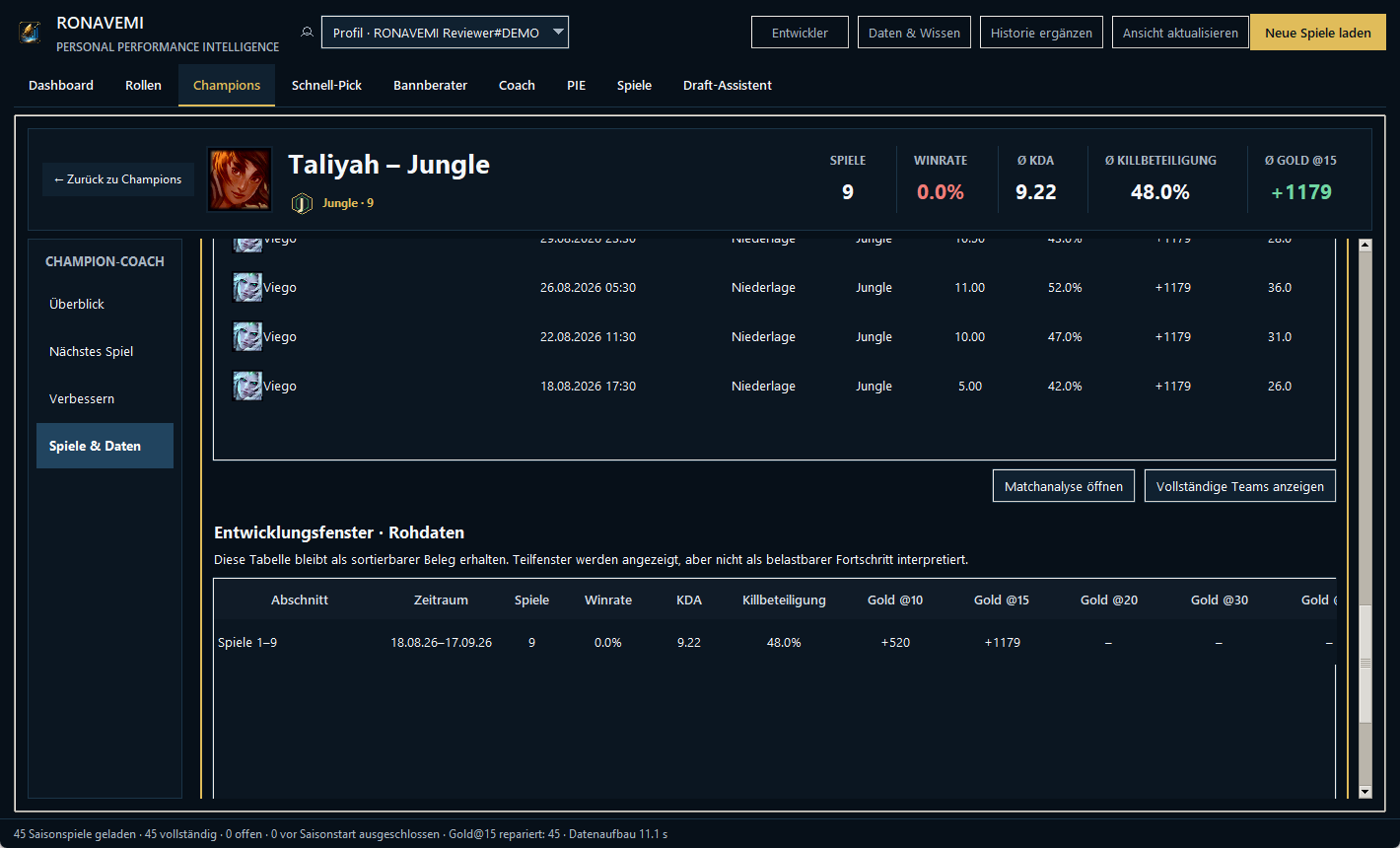
The completed games behind Taliyah Jungle conclusions, with match and development evidence.
What it does
Exposes sortable source rows and comparable windows behind champion-level analysis.
Player value
Makes coaching statements auditable instead of presenting an unexplained score.
Integrity
Uses completed matches and preserves missing values; no hidden live data.
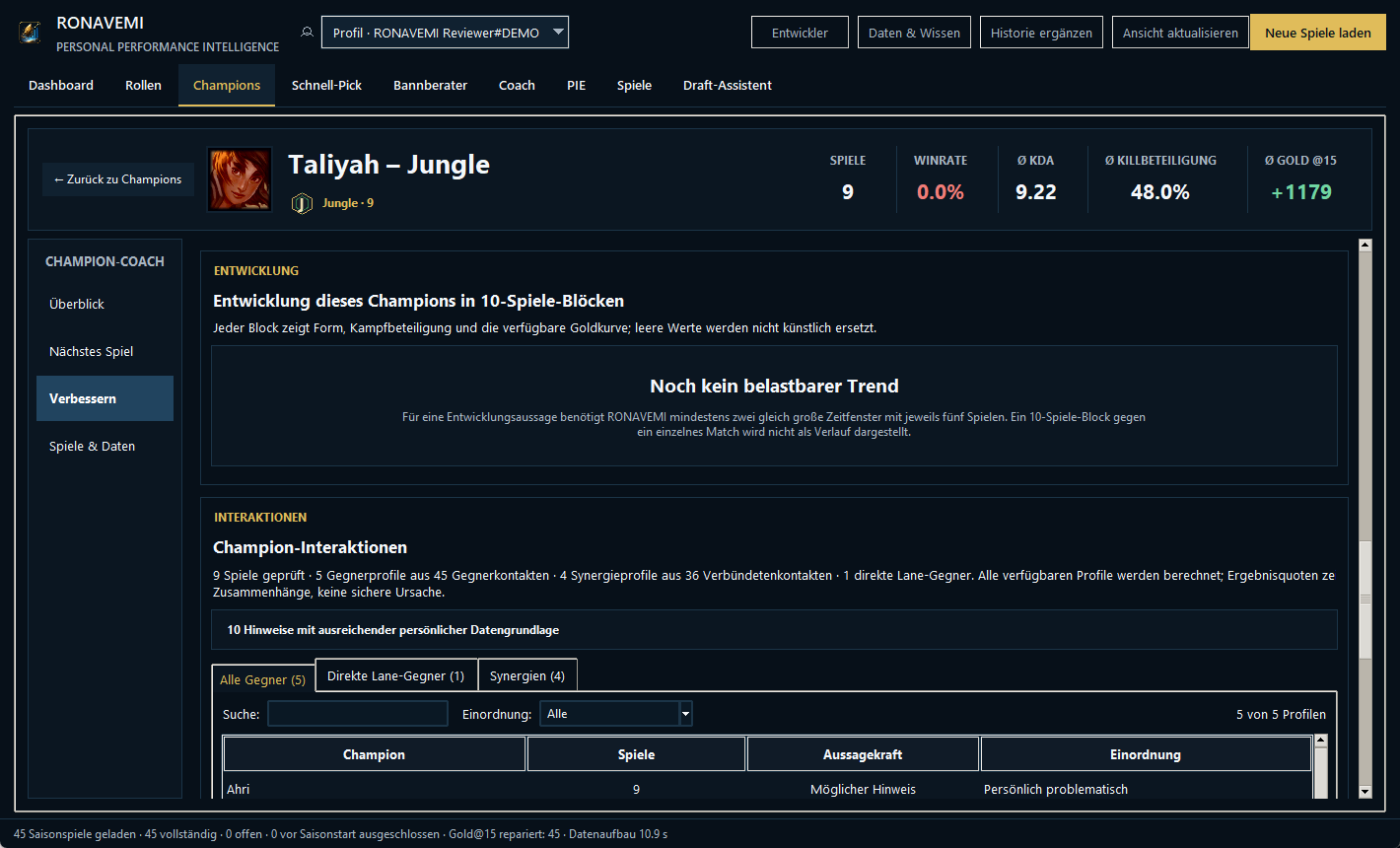
Champion-specific 10-game development windows and an explicit insufficient-trend state.
What it does
Compares equally sized completed-match windows only when the sample is sufficient.
Player value
Supports long-term improvement without turning a single match into a trend.
Integrity
Missing evidence stays missing; no causal claim or forced conclusion is created.
15 · PIE performance intelligence
Reviewer sees
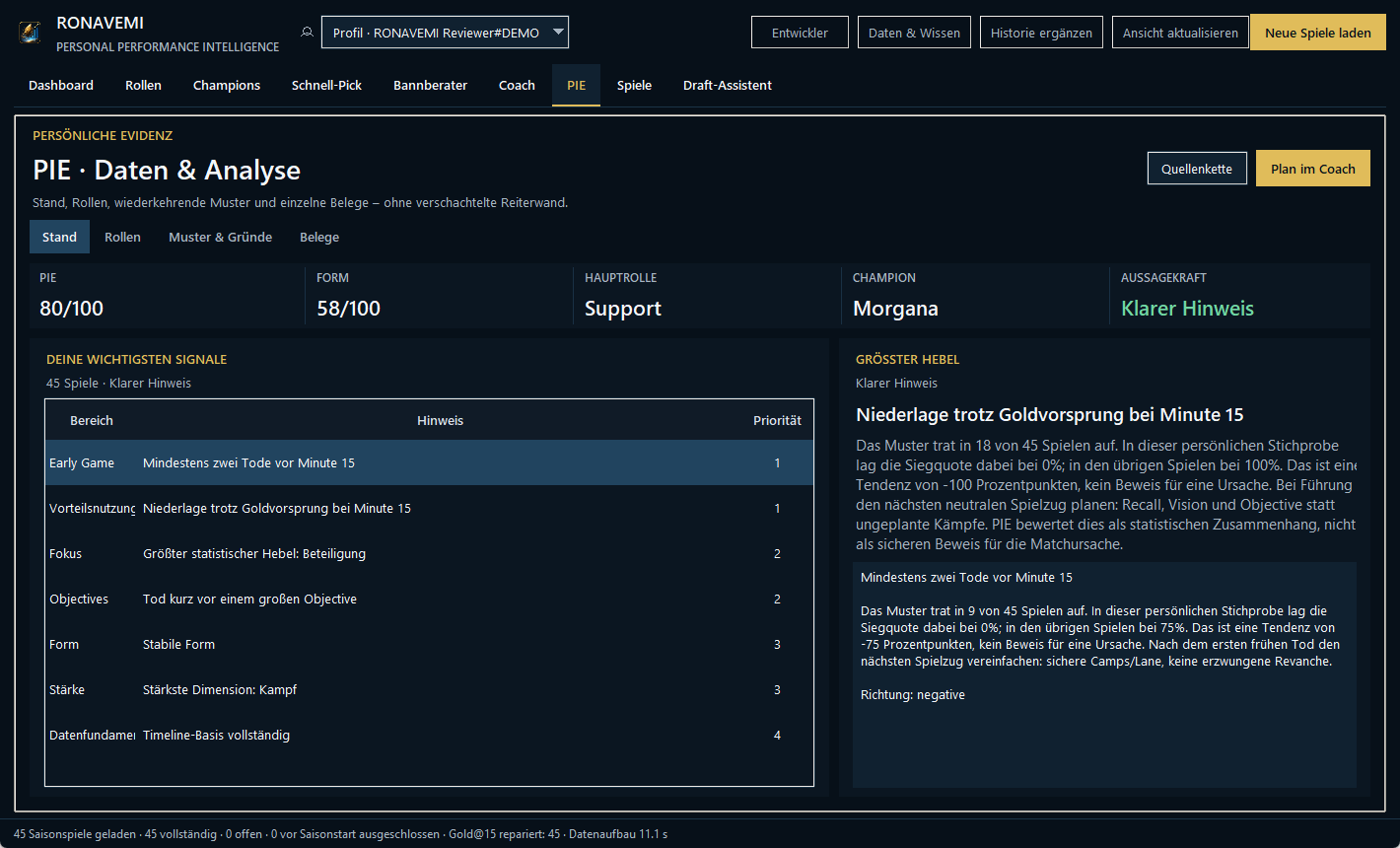
Cross-account signals, priorities, sample basis and explicit non-causal wording.
What it does
Consolidates recurring patterns across completed matches into evidence-ranked signals.
Player value
Helps the player select a learning priority before opening concrete Coach steps.
Integrity
Statistical association is labelled as association, not proof of cause or a command.
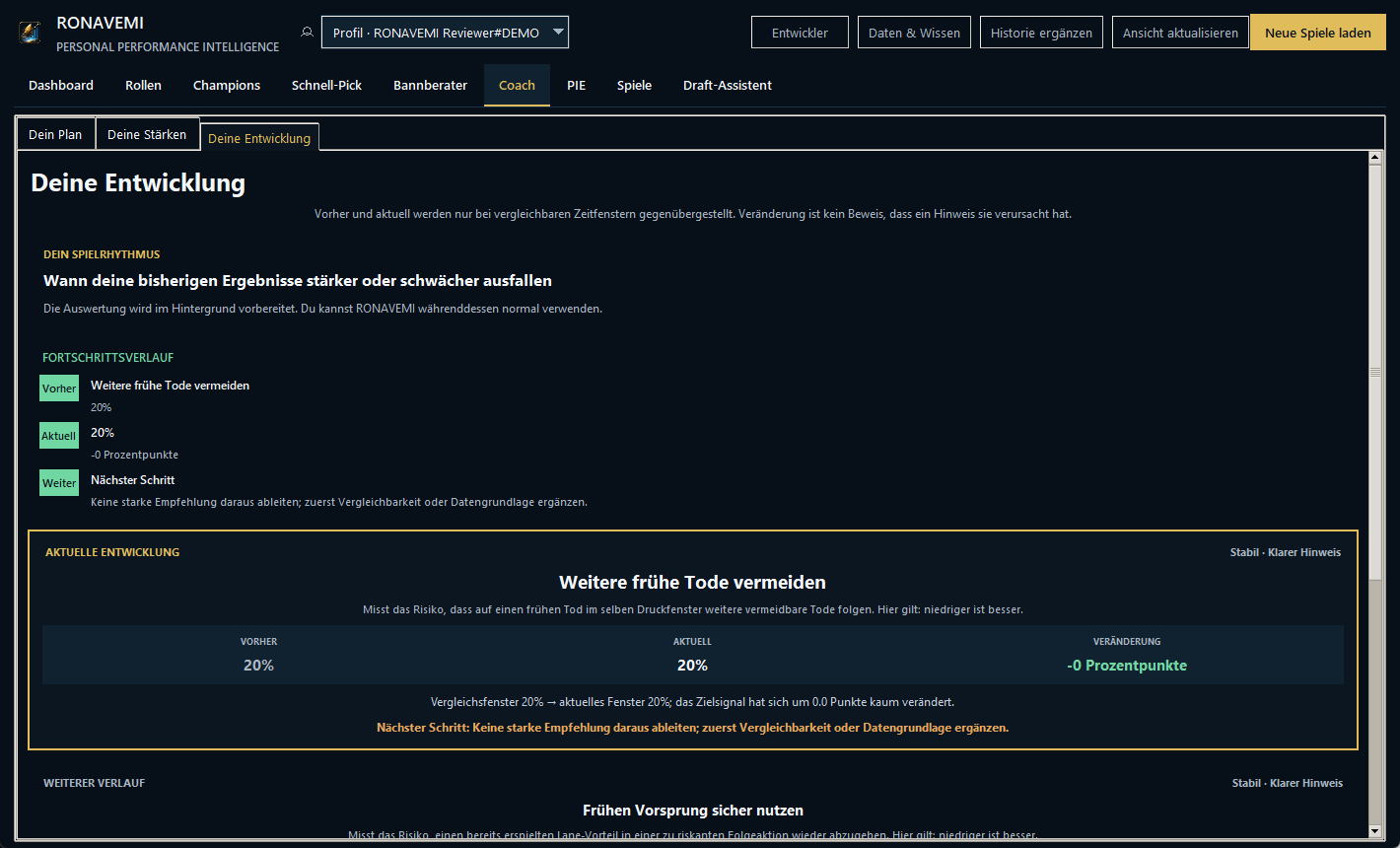
16 · CoachConcrete learning insights derived from the visible evidence keep uncertainty and non-causal boundaries explicit.17 · Training planA measurable five-game block with a stored baseline and explicit re-evaluation.
Trust, provenance and controls
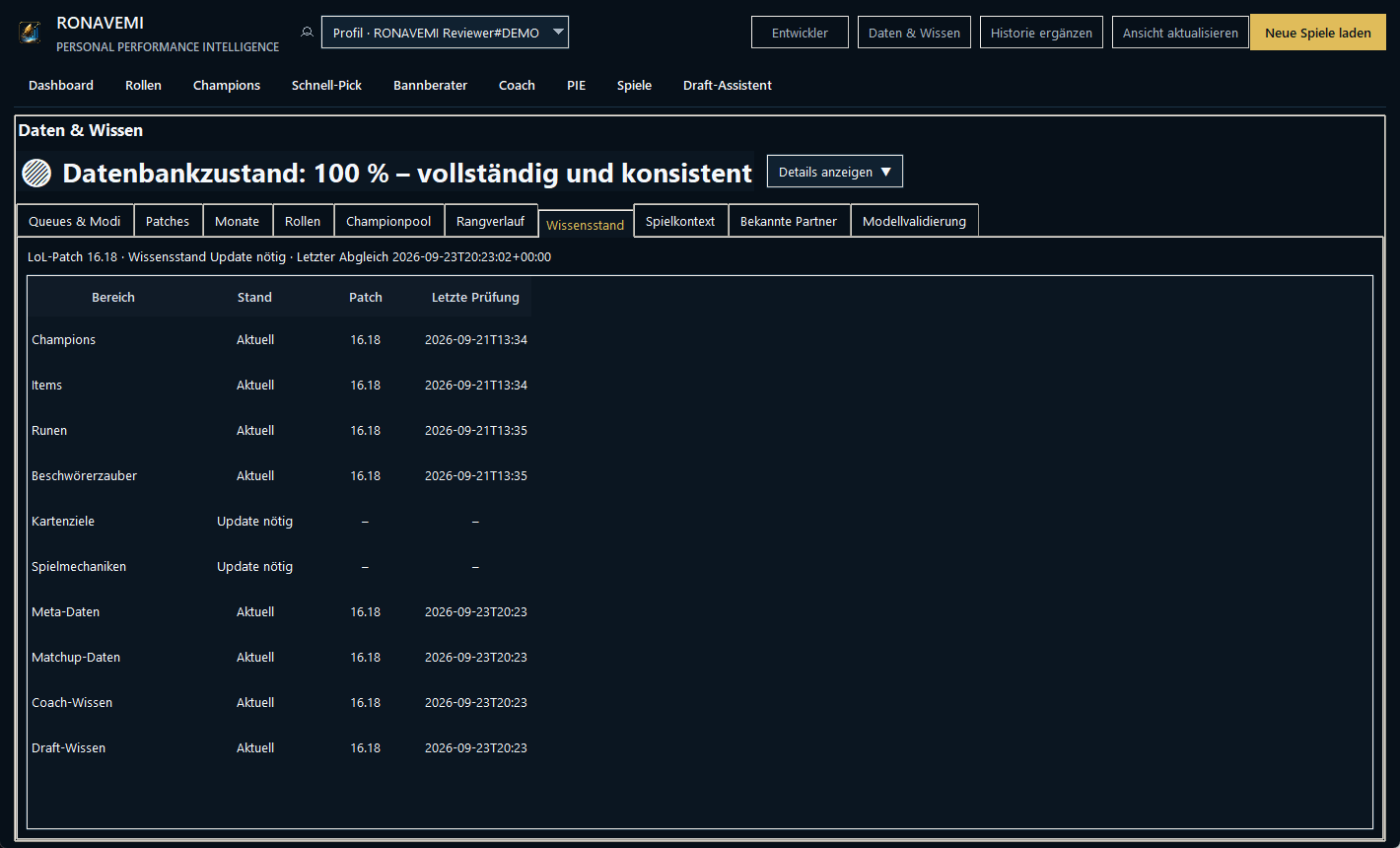
The product exposes data quality, source boundaries and its independent legal status.
18 · Data & KnowledgeCompleteness, patch freshness and knowledge provenance are inspectable in the product.19 · Model validation
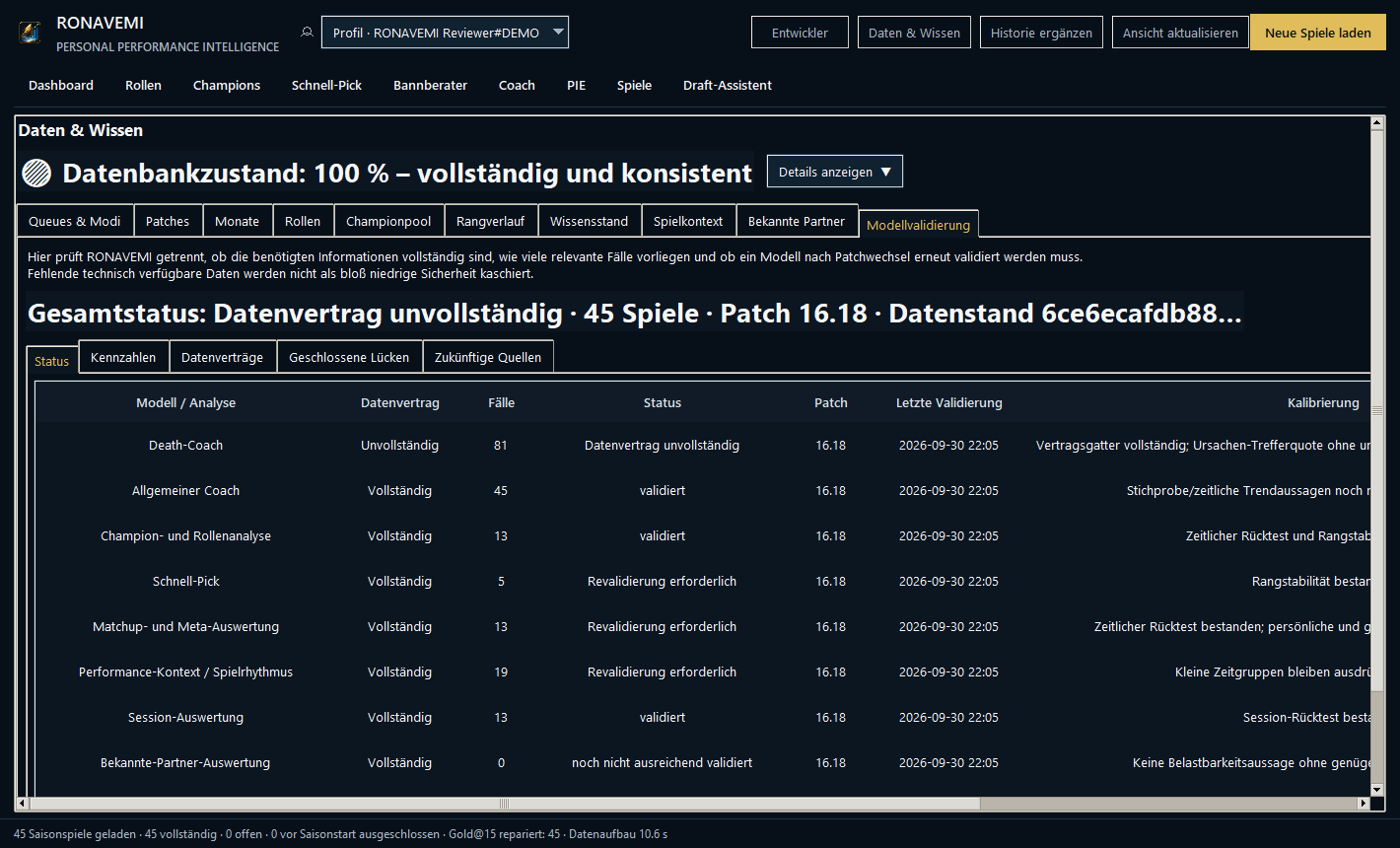
Reviewer sees
Patch-aware validation status, evidence coverage, case counts and explicit data-contract gaps.
What it does
Separates validated analyses from areas that require more evidence or revalidation after a patch change.
Player value
Makes the reliability and limits of derived coaching statements inspectable.
Integrity
No hidden or live data is inferred; incomplete contracts remain visibly incomplete.
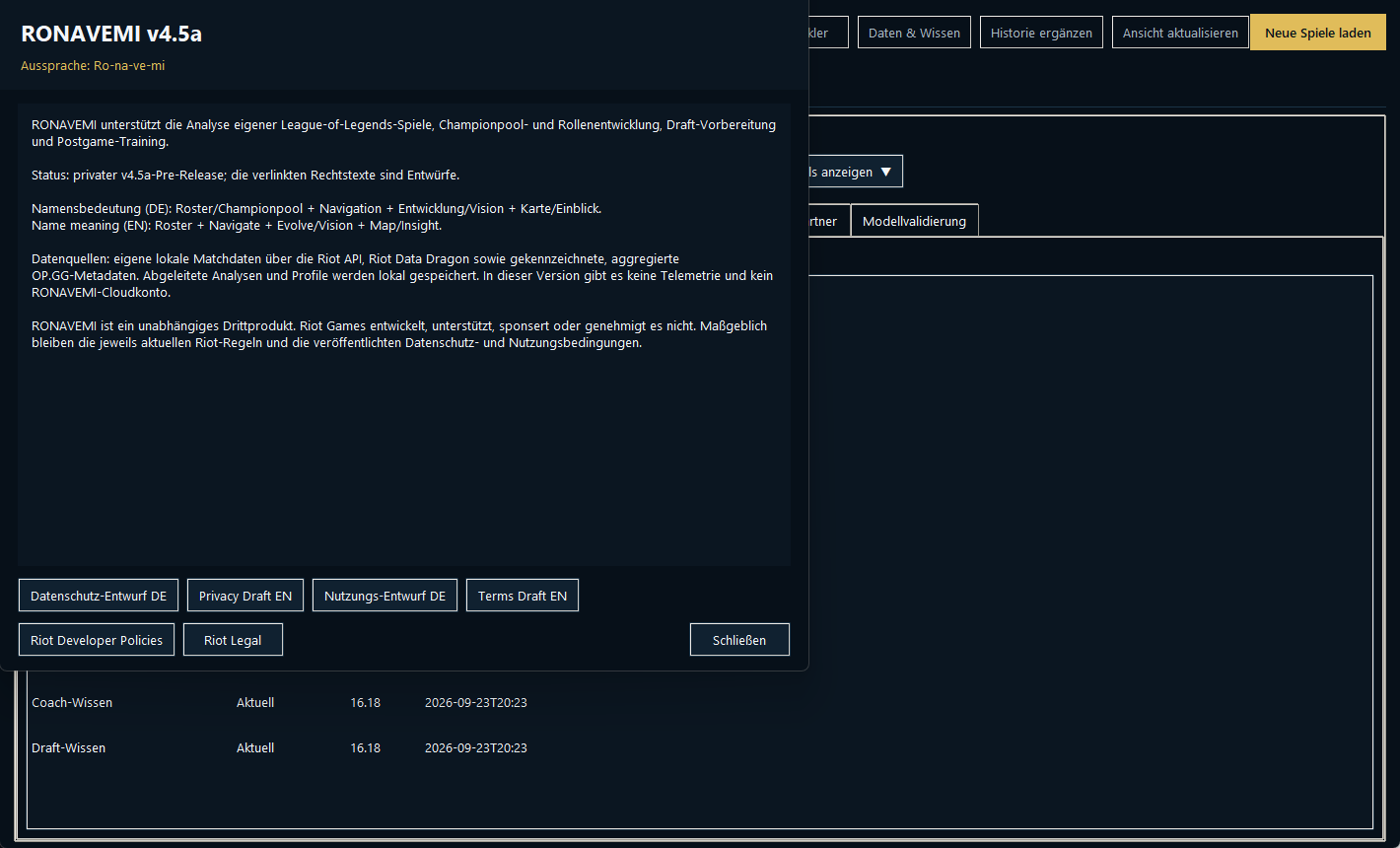
20 · About & LegalIndependent-product status, local-first summary, source disclosure and legal links.
User flow
A deliberate, player-controlled workflow.
The current build is a private pre-release prototype. A controlled test profile and redacted demonstration package can be supplied to Riot through an agreed secure channel.
01
Create a local profile
The player enters their own Riot ID, platform, and region.
02
Load permitted data
The player deliberately retrieves account, rank, completed-match, and timeline data through documented Riot API flows.
03
Review evidence
Dashboard, match review, and coaching views explain supported patterns; unclear evidence remains labelled as unclear.
04
Choose a training focus
RONAVEMI suggests reviewable priorities and several preparation options. The player makes the final decision.
05
Control local data
The player can inspect source and freshness information, export profile data, reset derived coaching data, and delete local match or profile data.
Planned Roadmap — Subject to Riot Review
Current functionality and future plans remain explicitly separate.
The items below describe direction after v4.5a. They are not presented as current functionality and may change based on technical feasibility, Riot review, and applicable policies.
CURRENT · v4.5a
Private pre-release / Riot review
Windows Desktop
League Client integration: Not active
Riot Sign On (RSO): Not active
Public download: Not available
Production API key: Not distributed with the application
PLANNED · v4.6
Live Companion Intelligence Foundation
Optional, Riot-disclosed League Client / LCU integration
Post-game LP change capture
Exact match-to-LP association where technically available
RSO where required and available or approved by Riot
Explicit user opt-in and transparent data sources
No hidden opponent information and no automated gameplay decisions. These features are not part of v4.5a.
PLANNED · v4.7
Second Screen
Matchup preparation and champion power spikes
Objective preparation and personal training focus
Situational educational guidance
Second Screen is intended as an information and learning tool, not as an automated shot-caller. It will use only information permitted by Riot rules and available to the player.
PLANNED · v4.8
Replay & VOD Integration
Connect post-game Coach and PIE insights to replay or VOD situations
Find relevant situations faster for post-game learning
No live-game manipulation
PLANNED · v4.9
Public Release Preparation
Stability and performance review
Compliance re-audit and security/distribution readiness
Installer and update review
Final public-release gate
PLANNED · v5.x
Multi-Platform Expansion
Only after a stable Windows version and the required release gates: Web, tablet, Android, iOS, and optional multi-device synchronization.
Planned features may change based on technical feasibility, Riot review and applicable policies. Planned features are not presented as current functionality.
Game integrity
Clear boundaries by design.
RONAVEMI supports
Post-game learning from completed matches
Longitudinal self-analysis
Static and aggregate preparation context
Multiple evidence-backed options
RONAVEMI does not
Automate gameplay or champion select
Reveal hidden players or unknown session data
Calculate an alternative MMR or ELO
Dictate one mandatory player decision
Data and sources
Local-first, transparent, and gated.
Version 4.5a has no RONAVEMI cloud account, cloud synchronization, telemetry, advertising, or tracking. Profiles, Riot identifiers, completed-match data, timelines, training history, and derived analytics are stored under the user’s Windows account.
Riot data
The private prototype uses Riot Account-v1, Match-v5, League-v4, a Summoner-v4 compatibility fallback, and Riot Data Dragon. Active requests use HTTPS.
API-key handling
A development key entered for private testing is held in process memory for that session and is not intentionally persisted. A production secret will not be embedded in the desktop client.
OP.GG data integration
RONAVEMI uses the OP.GG MCP integration for aggregated League of Legends champion and role statistics. On 2 October 2026, OP.GG Support confirmed that no separate written agreement is required for the described non-commercial distribution. Usage remains subject to applicable terms, service availability, reasonable request volumes, and access restrictions. RONAVEMI is an independent project and is not affiliated with or endorsed by OP.GG.
CURRENT · v4.5a
Current data-access boundary
No active LCU connection
No active RSO
No live companion and no post-game LP capture through LCU
No hidden opponent information
No automated control of the game
PLANNED · earliest v4.6
Future Riot-reviewed access
LCU would be used only for disclosed use cases such as post-game LP capture, precise match-to-LP association, and any other Riot-compliant companion functions. RSO would be used only if required and available or approved by Riot.
RONAVEMI is operated by Joel Standhaft, an individual developer in Germany. Missing postal operator details remain subject to legal review and have not been invented.